It is easy to understand why so many people want to take the Databricks-Certified-Data-Engineer-Professional exam even though they know how hard it is. In the past, just like the old saying goes “Practice makes perfect”, only the most hard-working workers who nearly spend most of their time on preparing for the exam can pass the exam as well as get the Databricks-Certified-Data-Engineer-Professional certification. However, things have changed with the passage of time, now I am glad to introduce our Databricks Databricks-Certified-Data-Engineer-Professional exam training material to you, with which you can achieve your goal with the minimum of time and efforts. If you choose our Databricks-Certified-Data-Engineer-Professional pdf test training to be your leaning partner in the course of preparing for the exam, I can assure that you will pass the exam as well as get your desired certification as easy as pie. There are numerous shining points of our Databricks-Certified-Data-Engineer-Professional exam training material which deserve to be mentioned, such as free trial available to everyone, mock examination available in Windows operation system, to name but a few.

Instant Download: Upon successful payment, Our systems will automatically send the product you have purchased to your
mailbox by email. (If not received within 12 hours, please contact us. Note: don't forget to check your spam.)
Mock examination available in Windows operation system
In our software version the unique point is that we will provide you the mock examination which will simulate the real exam for you to practice. There is no doubt that mock examination is of great significance for those workers who are preparing for the Databricks-Certified-Data-Engineer-Professional exam. First and foremost, workers can find deficiencies of their knowledge as well as their shortcomings in the Databricks Databricks-Certified-Data-Engineer-Professional exam lab questions, so that they can enrich their knowledge before the real exam. Second, many people are inclined to feel nervous when the exam is approaching, so the Databricks Databricks-Certified-Data-Engineer-Professional exam study material provided by us can help every candidate to get familiar with the real exam, which is meaningful for them to take away the pressure. Last but not least, our customers can accumulate exam experience as well as improving their exam skills with our Databricks-Certified-Data-Engineer-Professional updated study material. What's more, there is no limitation on our Databricks-Certified-Data-Engineer-Professional software version about how many computers our customers used to download it, but it can only be operated under the Windows operation system.
Free trial available to everyone
Our Databricks-Certified-Data-Engineer-Professional exam training material has been praised as the best study materials for the actual exam by our customers in many different countries. And it is clear that actions speak louder than words, we have enough confidence in our Databricks-Certified-Data-Engineer-Professional exam training material so that we provide the free demo for everyone to have a try, after trying, then you will understand why Databricks-Certified-Data-Engineer-Professional pdf study guide is so popular in the international market. Now, you only need to find the "download for free" item in our website, and you will notice that there are three kinds of versions for you to choose. What is called "A bold attempt is half success", I can assure that you will be fully satisfied with our Databricks Databricks-Certified-Data-Engineer-Professional online test simulator. We are always here waiting for giving you a hand, please feel free to have a try.
Databricks Databricks-Certified-Data-Engineer-Professional Exam Syllabus Topics:
| Section | Weight | Objectives |
|---|
| Topic 1: Data Ingestion & Acquisition | 7% | - Handle incremental and batch data loads
- Ingest data from diverse sources
- Use Auto Loader and structured streaming
|
| Topic 2: Debugging and Deploying | 10% | - Implement CI/CD and DevOps practices
- Troubleshoot and debug pipelines
- Deploy using Asset Bundles, CLI, and APIs
|
| Topic 3: Developing Code for Data Processing using Python and SQL | 22% | - Implement complex data processing logic
- Write efficient and maintainable code
- Use Databricks-specific libraries and APIs
|
| Topic 4: Data Modelling | 6% | - Design Medallion Architecture
- Optimize table design and partitioning
- Implement dimensional and relational models
|
| Topic 5: Monitoring and Alerting | 10% | - Monitor pipeline performance and health
- Track data lineage and metrics
- Set up alerts and notifications
|
| Topic 6: Data Sharing and Federation | 5% | - Implement Lakehouse Federation
- Use Delta Sharing for secure data sharing
- Manage cross-platform data access
|
| Topic 7: Data Transformation, Cleansing, and Quality | 10% | - Implement schema evolution and management
- Apply data cleansing and validation rules
- Enforce data quality standards
|
| Topic 8: Cost & Performance Optimisation | 13% | - Apply cost management best practices
- Optimize compute and storage resources
- Improve query and pipeline performance
|
| Topic 9: Ensuring Data Security and Compliance | 10% | - Secure data at rest and in transit
- Ensure data privacy and compliance
- Implement access control and permissions
|
| Topic 10: Data Governance | 7% | - Enforce data policies and standards
- Use Unity Catalog for governance
- Manage data assets and metadata
|
Databricks Certified Data Engineer Professional Sample Questions:
A data engineering team needs to create a SQL Alert that monitors data quality across multiple columns in their customer table. They want to trigger an alert when both the percentage of customers with missing email addresses exceeds 15% AND the percentage of customers with invalid phone number formats exceeds 10%. Which SQL query pattern is appropriate for implementing this multi-column alert condition?
- A. SELECT COUNT (*) FROM customers WHERE email IS NULL OR phone_format_invalid = true
- B. SELECT email_null_pct, phone_invalid_pct FROM (SELECT (COUNT(CASE WHEN email IS NULL THEN 1 END) *
100.0/COUNT (*)) as email_null_pct, (COUNT(CASE WHEN phone NOT RLIKE ''[0-9-+()\\s]+$' THEN 1 END)*
100.0/COUNT (*)) as phone_invalid_pct FROM customers)
- C. SELECT email, phone FROM customers WHERE email IS NULL AND phone NOT RLIKE ''[0-9-
+()\\s]+$'
- D. SELECT CASE WHEN email_null_pct >15 AND phone_invalid_pct> 10 THEN 1 ELSE 0 END FROM (SELECT (COUNT (CASE WHEN email IS NULL THEN 1 END) * 100.0 / COUNT (*)) as phone_invalid_pct FROM customers) metrics
Reveal Solution
Discussion
Correct Answer: B 🗳️
Explanation: Only visible for BraindumpsVCE members. You can sign-up / login (it's free).
The Databricks workspace administrator has configured interactive clusters for each of the data engineering groups. To control costs, clusters are set to terminate after 30 minutes of inactivity.
Each user should be able to execute workloads against their assigned clusters at any time of the day.
Assuming users have been added to a workspace but not granted any permissions, which of the following describes the minimal permissions a user would need to start and attach to an already configured cluster.
- A. Cluster creation allowed. "Can Attach To" privileges on the required cluster
- B. Workspace Admin privileges, cluster creation allowed. "Can Attach To" privileges on the required cluster
- C. "Can Restart" privileges on the required cluster
- D. Cluster creation allowed. "Can Restart" privileges on the required cluster
- E. "Can Manage" privileges on the required cluster
Reveal Solution
Discussion
Correct Answer: C 🗳️
Explanation: Only visible for BraindumpsVCE members. You can sign-up / login (it's free).
A data engineer is testing a collection of mathematical functions, one of which calculates the area under a curve as described by another function.
assert(myIntegrate(lambda x: x*x, 0, 3) [0] == 9)
Which kind of the test does the above line exemplify?
- A. Integration
- B. functional
- C. Manual
- D. Unit
- E. End-to-end
Reveal Solution
Discussion
Correct Answer: D 🗳️
Explanation: Only visible for BraindumpsVCE members. You can sign-up / login (it's free).
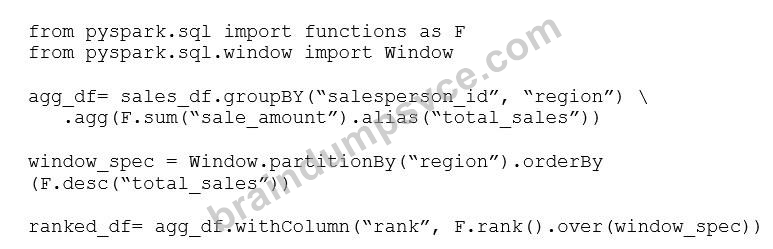
A data engineer is analyzing a large, partitioned retail dataset in Databricks, where each row represents a sale made by a salesperson. The dataset contains millions of records with the following schema:
sales_df: [salesperson_id: string, region: string, sale_amount: double, sale_date: date] The data engineer needs to generate a DataFrame that ranks salespeople within each region based on their total cumulative sales, with the highest seller ranked as 1. If multiple salespeople have the same total sales, they should share the same rank.
The data engineer wants to implement this logic using a PySpark window function and the dense_rank () function.
Which code snippet will perform this ranking?
Reveal Solution
Discussion
Correct Answer: D 🗳️
Explanation: Only visible for BraindumpsVCE members. You can sign-up / login (it's free).
Which statement describes Delta Lake Auto Compaction?
- A. An asynchronous job runs after the write completes to detect if files could be further compacted; if yes, an optimize job is executed toward a default of 1 GB.
- B. Data is queued in a messaging bus instead of committing data directly to memory; all data is committed from the messaging bus in one batch once the job is complete.
- C. An asynchronous job runs after the write completes to detect if files could be further compacted; if yes, an optimize job is executed toward a default of 128 MB.
- D. Before a Jobs cluster terminates, optimize is executed on all tables modified during the most recent job.
- E. Optimized writes use logical partitions instead of directory partitions; because partition boundaries are only represented in metadata, fewer small files are written.
Reveal Solution
Discussion
Correct Answer: C 🗳️
Explanation: Only visible for BraindumpsVCE members. You can sign-up / login (it's free).
Viewing page 1 out of 50 pages.
Viewing questions 1-5 out of 250 questions.




 Joanna

 Murray
 Byron
 Elliot

 Giselle
 Olive
 Otto
 Hayden
 Colby
 Mildred
 Leopold

 Candice
 Violet
 Monroe