
[Full-Version] 2024 New Preparation Guide of HP HPE7-A07 Exam
HPE7-A07 Practice Exam - 70 Unique Questions
NEW QUESTION # 38
A customer would like to allow their IT Helpdesk to configure loT devices to connect lo a single SSID using a unique PSK that other devices cannot use. Which solution would you recommend?
- A. MPSK AES with MAC Auth
- B. MPSK AES with ClearPass
- C. MPSK AES with Cloud Auth
- D. MPSK Local
Answer: B
Explanation:
Multi-Pre-Shared Key (MPSK) with ClearPass is the recommended solution for a scenario where the IT Helpdesk needs to configure IoT devices to connect to a single SSID using unique PSKs. MPSK allows for the use of different PSKs on the same SSID, and ClearPass enables the management of these unique keys efficiently.
NEW QUESTION # 39
Exhibit.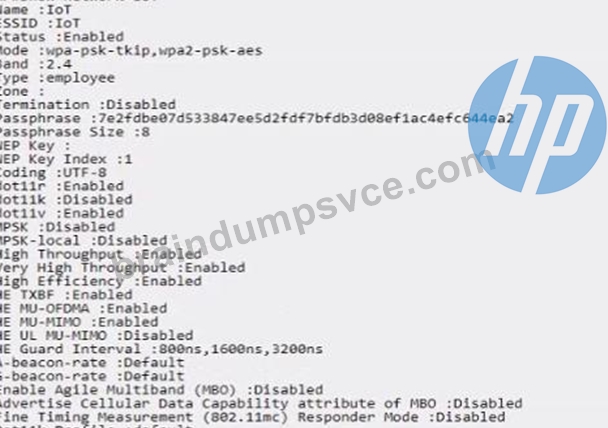
Which statement is true?
- A. The SSID supports RC4 encryption.
- B. The SSID supports 802.11nac clients.
- C. The SSID supports implicit beamforming.
- D. The SSID supports sending neighbor reports.
Answer: B
Explanation:
The SSID supports 802.11ac clients, which is indicated by the "High Throughput" and "Very High Throughput" options being enabled. These are terms associated with the 802.11ac wireless standard, indicating that the SSID can serve clients that support this technology.
NEW QUESTION # 40
Your customer is requesting a4-ciass LAN queuing model tor QoS. Following best practices, match the PHB/DSCP values to the application types.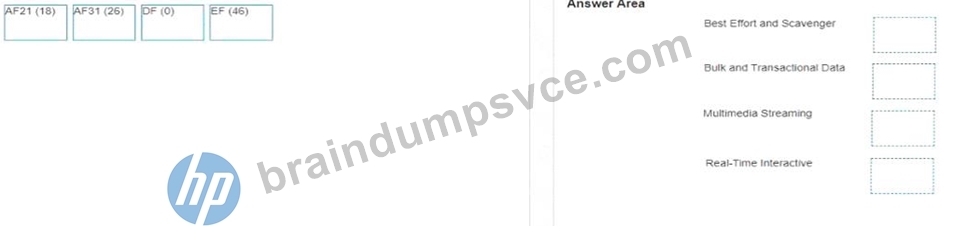
Answer:
Explanation: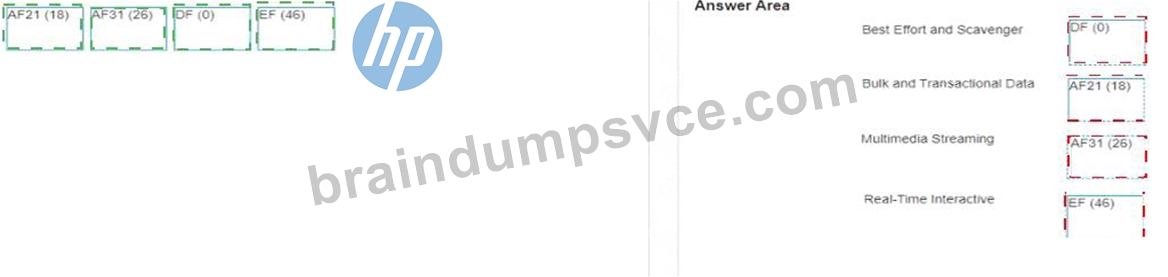
Explanation:
Best Effort and Scavenger =DF (0)Bulk and Transactional Data =AF21 (18)Multimedia Streaming =AF31 (26)Real-Time Interactive =EF (46)
NEW QUESTION # 41
You configured" a bridgedmode SSID with WPA3-Enterprise and EAP-TLS security. When you connect an Active Directory joined client that has valid client certificates. ClearPass shows the following error.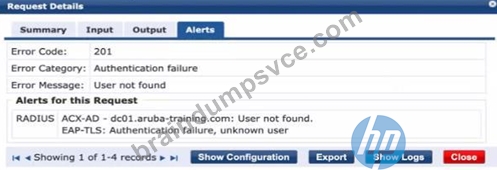
What is needed to resolve this issue?
- A. Modify your ACX-AD authentication source to include the UPN in the search.
- B. Enable authorization in your Authentication Method.
- C. Configure ClearPass to trust the client certificate.
- D. Recreate the SSID m tunneled mode.
Answer: A
Explanation:
The error message "User not found" indicates that the authentication source, in this case, Active Directory (AD), is not able to locate the user account based on the current search parameters. This often occurs when the User Principal Name (UPN) that the client is using to authenticate is not included in the search parameters of the AD authentication source within ClearPass. By modifying the AD authentication source to include the UPN in the search, ClearPass will be able to correctly locate the user account and proceed with the authentication using the valid client certificates.
NEW QUESTION # 42
Refer to the CLI output below:
What statement about the output above is correct?
- A. The port-access role was configured with gateway-role visitor
- B. The UBT zone was configured to use a user-defined VRF
- C. The client authenticated using dot1x.
- D. The secondary tunnel endpoint IP is 10.10-10.151.
Answer: D
Explanation:
The CLI output indicates a tunnel creation process, where "SW hw tun created" refers to the switch hardware tunnel being created. The line mentioning "BYP-10.10.10.101 -> SW hw tun created to 10.10.10.151 tunnel
15." implies that a tunnel was established to the secondary tunnel endpoint with the IP address 10.10.10.151.
This is a common configuration for User-Based Tunneling (UBT) setups where traffic is tunneled to a specific endpoint.
NEW QUESTION # 43
Exhibit.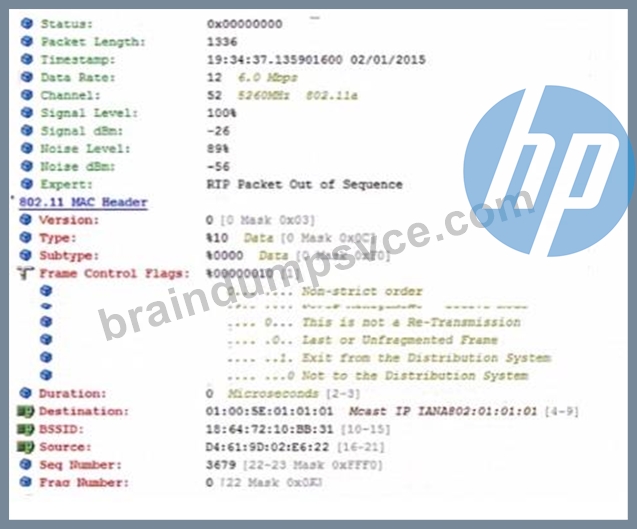
A university runs its own TV station in the city The IT department deploys a multimedia server so the TV productions can be sent out to the entire campus over the IP network using multicast-based communications in order to improve the bandwidth consumption. PlM sparse Mode and IGMP snooping features are enabled.
When wireless users join the multicast groups, all users connected to the same WLAN experience poor network performance. However, wired users are not affected in this way While troubleshooting the network administrator saves the packet captures shown in the exhibit and concludes that all users even those not joining the multicast group, receive the same multicast flow at slow speeds.
Which features should the network administrator enable to fix the problem?
- A. Dynamic Multicast Optimization and UCC QoS correction
- B. Dynamic Multicast Optimization and Multicast Transmission Optimization
- C. ARP broadcast conversion into unicast and Multicast Transmission Optimization
- D. UCC QoS correction and Multicast Transmission Optimization
Answer: B
Explanation:
Dynamic Multicast Optimization (DMO) and Multicast Transmission Optimization are features that can help address issues with multicast traffic in wireless environments. DMO optimizes the way multicast traffic is transmitted over the air by converting multicast streams into unicast streams to the clients that need them. This reduces unnecessary traffic for clients that have not subscribed to the multicast group and can improve overall network performance. Multicast Transmission Optimization adjusts the transmission rate of multicast frames to ensure they are sent at optimal speeds, addressing the issue of multicast flow being received at slow speeds by all users.
NEW QUESTION # 44
A customer is evaluating device profiles on a CX 6300 switch. The test device has the following attributes:
* MAC address = 81:cd:93:13:ab:31
* LLDP sys-desc = iotcontroller
The test device is being assigned to the ''lot-dev'' role However, the customer requires the "lot-prod'' role be applied.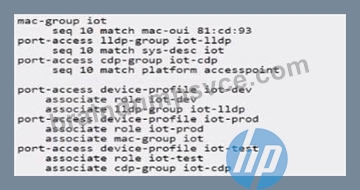
Given the configuration, what is causing the "iot-dev" role to be applied to the device'?
- A. An external RADIUS server is unreachable.
- B. The device-profile precedence order is not configured.
- C. The LLDP system description matches the IIdp-group configuration.
- D. The test device does not support CDP.
Answer: C
Explanation:
In device profile configuration, the device role is often determined by matching attributes such as MAC address, LLDP system description, and CDP information against defined conditions. The test device is being assigned the "iot-dev" role because its LLDP system description matches the 'iot-lldp' group configuration that is associated with the 'iot-dev' role.
NEW QUESTION # 45
An OSPF router has learned a pain 10 an external network by Doth an E1 and an E2 advertisement Both routes have the same path cost Which path will the router prefer?
- A. The router will use Doth paths equally utilizing ECMP.
- B. The router will prefer the E1 path.
- C. The router will prefer the E2 path.
- D. Both routes will be suppressed until the path conflict has been resolved.
Answer: B
Explanation:
In OSPF, when a router learns about an external network through both E1 and E2 advertisements, and if both have the same path cost, the router will prefer the E1 path. This is because E1 routes consider both the external cost to reach the external network and the internal cost to reach the ASBR, providing a more comprehensive metric. E2 routes only consider the external cost and ignore the internal cost to the ASBR, which could potentially lead to suboptimal routing. Therefore, the router will choose the E1 path due to its more accurate representation of the total path cost.
NEW QUESTION # 46
Which command would allow you to verity receipt of a CoA message on an AOS 10 GW?
- A. packet-capture controipath udp 3799
- B. packet-capture datapath udp 3799
- C. packet-capture interprocess udp 3799
- D. tcpdump host-port 3799
Answer: A
Explanation:
The Change of Authorization (CoA) messages are used in network access control scenarios and are typically received by the network access server, in this case, an Aruba AOS 10 Gateway. The correct command to verify the receipt of a CoA message is related to the control path traffic because CoA is a control plane function.
Option B,packet-capture controlpath udp 3799, is the correct answer because it specifies capturing control plane traffic on UDP port 3799, which is the standard port for CoA messages.
Options A, C, and D are incorrect because:
Option A captures data plane traffic, not control plane traffic.
Option C'spacket-capture interprocess udp 3799does not refer to a standard command for capturing CoA messages.
Option D,tcpdump host-port 3799, does not specify the correct syntax for capturing traffic on Aruba devices.
NEW QUESTION # 47
A university owns a campus with several buildings segmented into east and west wings, which are L3 separated. The east wing has 1600 APs. and the west wing has 1200 Aps. Each wing has a single gateway cluster managed by HPE Aruba Networking Central. Each cluster contains one 7210 mobility gateway The gateways are configured with DHCP relay and route all client VLANs. A new business-critical facultyreal-time application requires users to roam within wings but not across wings without disconnections or delay increments.
Which changes must the network administrator make lo successfully meet the requirement without performance degradation matching best practices? (Select two.)
- A. Replace me 7210 mobility gateway in the east wing with a pair or 9012 mobility gateways
- B. Add a single 7210 mobility gateway to each cluster.
- C. Run L2 for all SSIDs and permit the users' VLANs in the gateway's uplinks.
- D. Remove the DHCP relay from the gateways and enable the DHCP server instead
- E. Replace the 7210 mobility gateway in the west wing with a pair of 7030 mobility gateways.
Answer: B,C
Explanation:
To support a business-critical faculty real-time application that requires seamless roaming within wings without cross-wing roaming, it's essential to ensure high availability and sufficient capacity. Adding an additional 7210 mobility gateway to each cluster would provide the required redundancy and capacity.
Running L2 for all SSIDs and permitting user VLANs on gateway uplinks would facilitate the necessary traffic flow without L3 segmentation issues, thus supporting seamless roaming within each wing.
NEW QUESTION # 48
You created a new SSID with the security settings shown in the exhibit.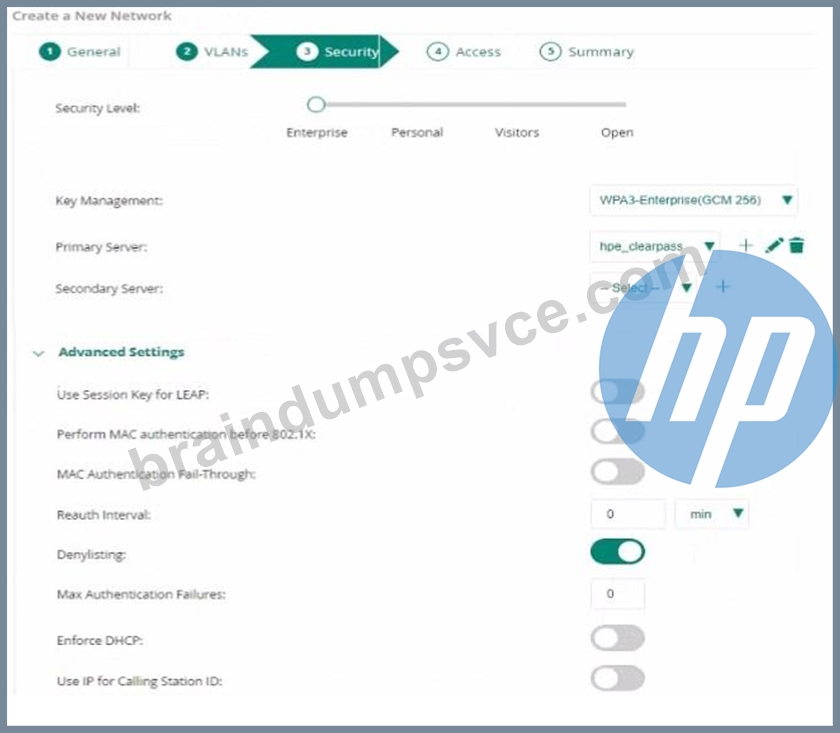
Some, but not all users complain that client devices are unable to connect to this SS1D. What is the reason for this?
- A. MAC authentication after a failed 802. ix authentication is not possible as the option "MAC Authentication Fall-Through" is disabled.
- B. WPA3 Enterprise is not backward compatible with WPA2 Enterprise.
- C. The WPA3 Enterprise GCM-2S6 mode does not support transition mode.
- D. The primary servers shared key differs from the shared key configured for this server on HPE Aruba Networking Central.
Answer: A
Explanation:
If some users are unable to connect to an SSID configured with WPA3-Enterprise GCM-256, and the "MAC Authentication Fall-Through" is disabled, it means that devices which fail 802.1X authentication will not attempt MAC authentication. If these client devices are configured to use MAC authentication as a backup method, they will fail to connect, explaining the issue faced by some users.
NEW QUESTION # 49
Exhibit.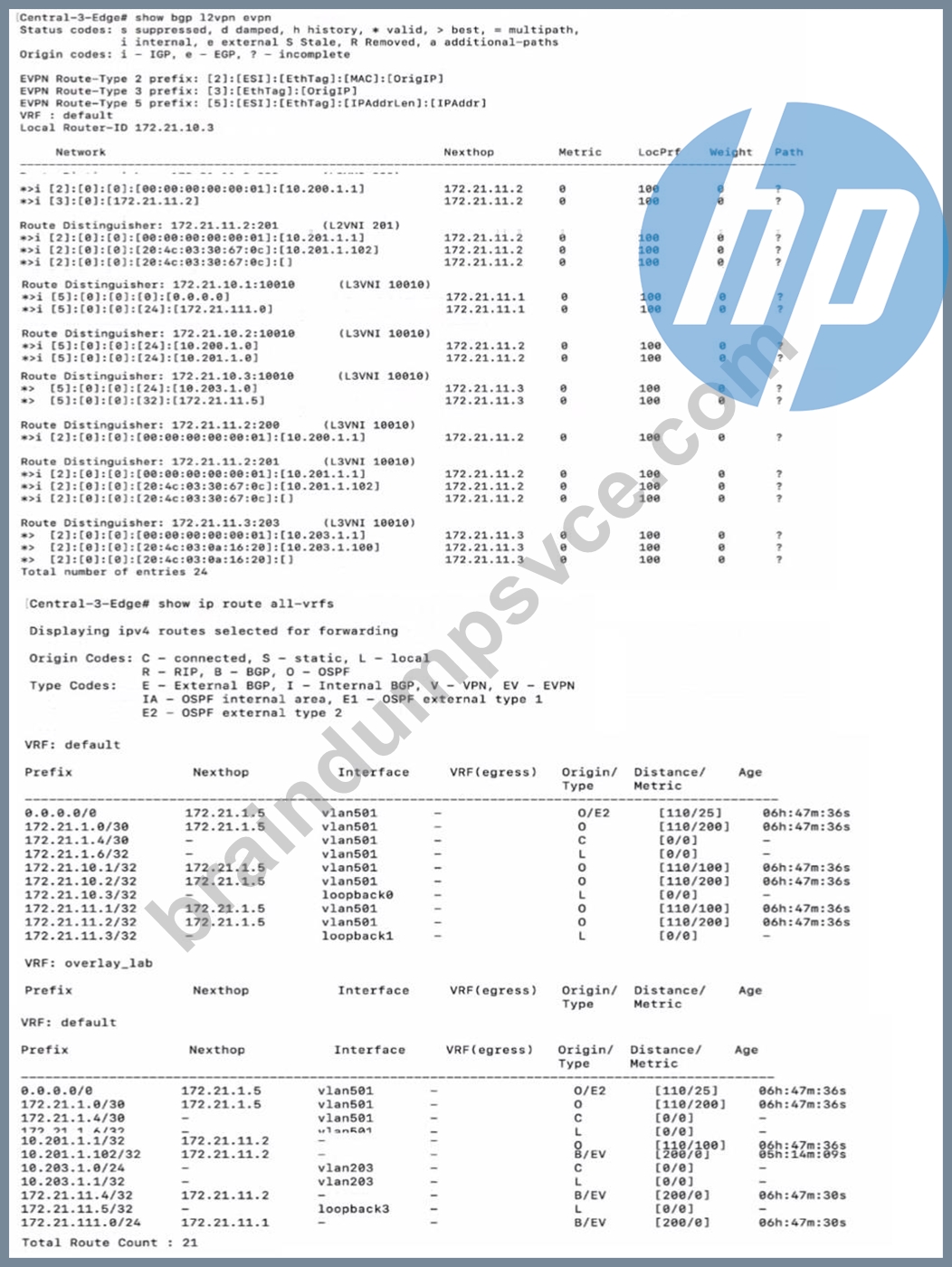
Which statement is true given the following CLI output from a CX 6300?
- A. A wired client with IP address 10 203 1 100 has a host route that is not being properly advertised
- B. The overlay loopbacK addresses are advertised in the faerie with 2d-bit subnet masks
- C. A wired client with IP address 10.203 1.100 is on a remote CX 6300 in the fabric with loopback IP address 172.21.11.2.
- D. There are no active fabric clients on the CX switch with RD 172.16.10.1
Answer: C
Explanation:
The CLI output provided shows routing information from a CX 6300 switch. The output under "VRF: default" shows various IP routes, including a route for 10.203.1.100/32 with a next hop of 172.21.11.2. This indicates that the route to the client with IP address 10.203.1.100 is known in the network and is reachable via another device in the fabric, which has the loopback IP address 172.21.11.2. Since the route is present in the routing table, it means that the client is known and active within the fabric network.
NEW QUESTION # 50
A deployment using AP-635S is connectedto a stack of CX 6300s as shown.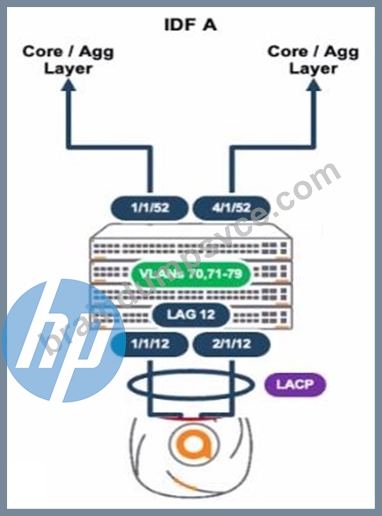
The output of the snow LACPinterfaces shews the following: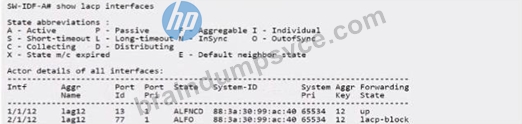
What is causing this issue?
- A. The AP is configured with LACP active
- B. Spanning tree and loop protect are enabled on both AP uplink ports.
- C. e0 is connected to a smart rate interface, and e1 is connected to a non-smart rate interface.
- D. Each AP interface is connected to a routed-only interlace on different networks
Answer: A
Explanation:
In an Aruba deployment, if an AP's interfaces show different LACP states, it often indicates a configuration mismatch. If one interface is up and the other is blocked as shown in the output,it's likely due to both interfaces on the AP being set to LACP active mode, which is a correct setting for establishing an LACP channel with Aruba switches like the CX 6300 series.
NEW QUESTION # 51
The ACME company has an AOS-CX 6200 VSF switch slack with an uplink over subscription ratio of 9.6:1.
They have indicated that their low-priority TCP traffic has been flagged with a DSCP marking coloring them yellow.
Refer to the exhibit.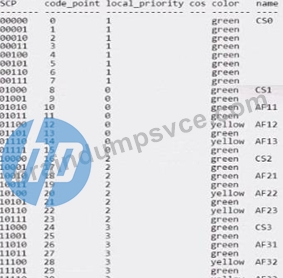
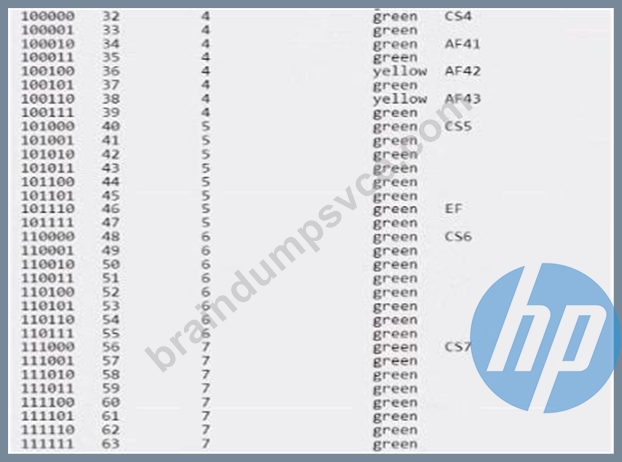
They are considering adding two more nodes to thestack without adding any additional uplinks due to existing wiring constraints.One of their architects has suggested adding the following configuration:
What would be the impact of applying the acmethreshold profile as shown? (Select two.)
- A. Only VoIP packets egressing queue 5 on LAG1 will likely be protected from uplink over-utilization.
- B. Yellow-flagged TCP traffic egressing LAG1 will be subject to drop probability
- C. All TCP traffic egressing LAG1 wail be subject to drop probability
- D. VoIP packets egressing any queue on LAG1 will more likely be protected from uplink over-utilization
- E. All upper-layer protocol traffic egressing LAG1 will be subject to drop probability.
Answer: B,E
Explanation:
Applying the 'acmethreshold' profile as shown in the exhibit would set a minimum and maximum threshold for queue 0, which affects the drop probability for traffic that exceeds these thresholds. The yellow marking indicates a medium drop precedence, so yellow-flagged traffic would be more likely to be dropped when congestion occurs, and the uplink is over-utilized. This action is intended to protect higher-priority traffic, such as VoIP, by giving it a lower probability of being dropped.
NEW QUESTION # 52
Exhibit.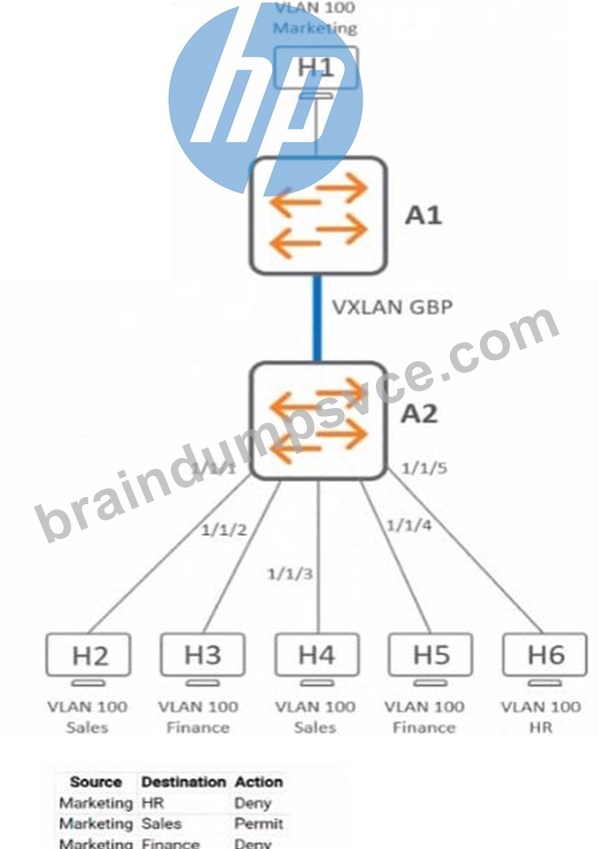
What is me expected behavior for ARP traffic sent from H1?
- A. A2 will send the ARP traffic out of ports 1/1/1-1/1/4.
- B. A2 willflood the ARP traffic out of all interfaces.
- C. A2 willsend the ARP traffic out of ports 1/1/1 and 1/1/3.
- D. A2 will drop the ARP traffic.
Answer: B
Explanation:
In a VXLAN environment, unknown unicast traffic, such as ARP requests from H1, which does not have a specific destination MAC address learned by the switch A2, will be flooded out of all interfaces. This flooding behavior is necessary because A2 needs to ensure that the ARP requestreaches its intended destination, which might be on any of the interfaces. It's a part of the standard behavior of switches to handle ARP traffic when the destination hardware address is unknown.
NEW QUESTION # 53
A customer is running out of IP addresses in a network segment. What will happen If they add an additional IPsubnet to the same VLAN?
- A. IGMP will not work in both of the subnets in the same VLAN
- B. This would result in a single SVI using two subinterfaces.
- C. Users can reach each other and establish PTP traffic without passing an L3 point in the same VLAN
- D. Broadcasts for me two subnets win arrive on all ports in the same VLAN
Answer: C
Explanation:
Adding an additional IP subnet to the same VLAN means that devices configured with either subnet can communicate at Layer 2 without the need for routing. This is because they are on the same VLAN and thus in the same broadcast domain. However, to communicate between subnets, an L3 device or inter-VLAN routing would be required.
NEW QUESTION # 54
A customer is planning to add loT devices that connect wirelessly to the existing 802.1X SSlD. The customer will use ClearPass to authenticate the IoT devices by MAC address but other devices will still need to authenticate by only 802 1X Exhibit.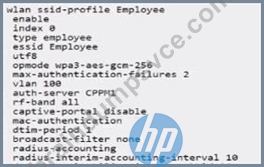
The customer provided the current configuration and reported their non-loT 802. IX devices are no longer able to connect. Which configuration change can be made to fix the issue?
- A. Modify max-authentication failures to 0.
- B. Remove mac-authentication from the WLAN configuration
- C. Modify opmode wpa3-aes-gcm-256 to opmode wpa2-aes
- D. Add i2-autn-fairtnrougn to the WLAN configuration
Answer: B
Explanation:
The existing configuration for the WLAN ssid-profile has enabled MAC authentication which, while suitable for IoT devices that may not support 802.1X, can interfere with the normal 802.1X authentication process for other devices. By removing themac-authenticationdirective from the WLAN configuration, the non-IoT
802.1X devices should be able to connect without issues as the authentication process will not be disrupted by MAC authentication checks. This adjustment ensures that the WLAN ssid-profile is correctly aligned with the authentication requirements for both IoT and non-IoT devices within the network environment, conforming to the best practices for mixed-device WLAN configurations.
NEW QUESTION # 55
......
Latest Questions HPE7-A07 Guide to Prepare Free Practice Tests: https://freetorrent.braindumpsvce.com/HPE7-A07_exam-dumps-torrent.html